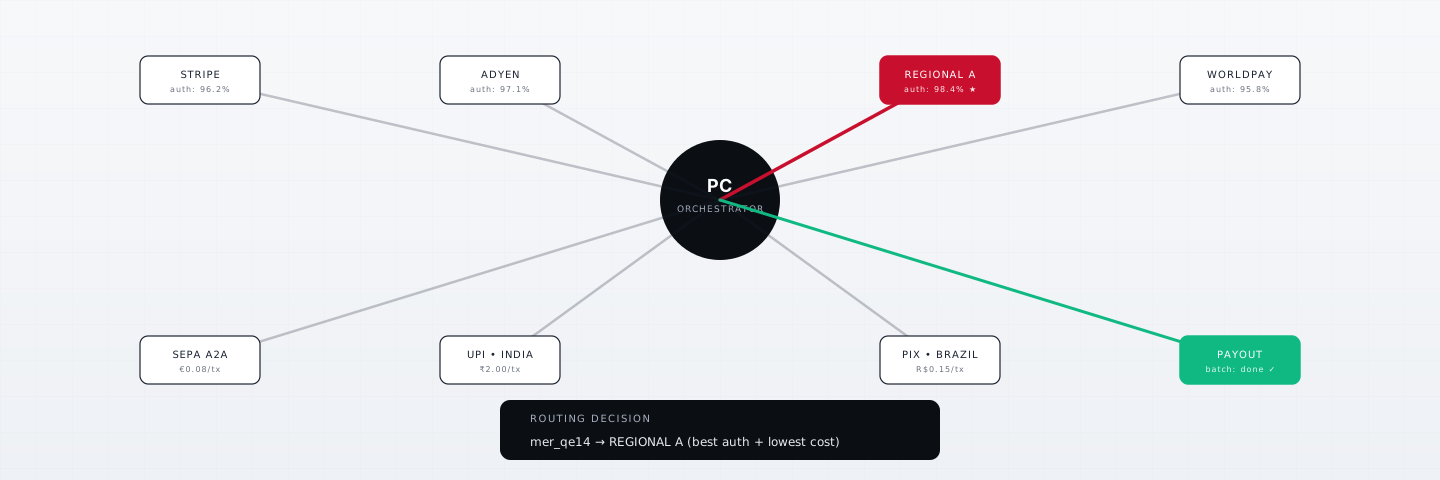
When do you actually need payments orchestration?
Payments orchestration is the most over-pitched and under-explained category in fintech. Half the founders we talk to don't know whether they need it. So here's the honest framework we give them.
You don't need orchestration if you're processing under roughly $10M/year through a single PSP, your business is one product line in one geography, and your finance team is happy with the daily settlement file your PSP sends. At that scale, the cost (engineering time, vendor fees, and the abstraction tax) outweighs the upside. Stay on Stripe, Adyen, or whoever you started with. Build product instead.
You probably need orchestration if any of these are true:
- You're routing more than ~$25M/year and your auth rate is the difference between a good quarter and a flat one.
- You operate in three or more geographies and your single PSP has visibly worse approval rates in at least one of them.
- You're a platform with sub-merchants and you're hand-rolling settlement logic in production code.
- Your finance team is rebuilding the reconciliation file in a spreadsheet every morning.
- You've been told "no" by your PSP on a feature you actually need (split payments, escrow, programmable payouts) and you don't want to wait six quarters for them to ship it.
You definitely need orchestration if you're an acquirer or a regulated entity yourself, and you're now reselling payments to other businesses. At that point you don't need orchestration on top of a PSP — you need processing rails. That's a different product (we ship one called PCPS).
The honest version is that orchestration is mostly a cost question and a control question. Cost: at scale, even small improvements in approval rates pay for the orchestration layer many times over. Control: orchestration moves the routing, retry, and settlement logic into code your team owns, instead of into a black box your team can't reach.
If you're trying to figure out whether you're at the threshold, the cheapest thing you can do is run the math on auth-rate uplift. Take your current authorized volume, model a 1.5–3% absolute uplift on auth rate (conservative, achievable across a 2-acquirer routing setup with sensible retries), and see what that's worth annually. Compare to the orchestration platform's all-in cost. If the math is uncomfortable, you have your answer.
We built Payments Central for exactly this customer profile, and we publish our pricing on the page. If you want a working sandbox and a payments engineer on a call, we can do that this week.